
Blog Topics:

How to Ship Fragile, Valuable and Awkward Items Safely
How to Ship Fragile, Valuable, and Awkward Items Without Losing Sleep
Carriers handle thousands of packages a day. Yours is one of them — unless someone at the origin point made absolutely sure it wouldn't be.
Every year, millions of packages arrive damaged. The item was fine when it left. The box looked fine on the porch. But inside: a cracked corner, a shattered screen, a ceramic piece in three pieces, a guitar neck snapped clean. The carrier's damage claim process is slow, pays less than you expect, and doesn't restore the sentimental value of what you lost. Our custom packing page explains what we pack and how.
The fix isn't a better insurance policy. It's better packing — the kind that accounts for what the package will actually go through between your hands and the recipient's door.
At The Mail Station Monroe, we've been packing and shipping for the Monroe community since 1982. We've seen what cheap boxes and insufficient cushioning do to antiques, instruments, electronics, and art. We've also seen what professional packing does: it makes damaged claims a rarity instead of a routine.
What Packages Actually Go Through in Transit
The assumption most shippers make — that packages travel gently from point A to point B — is wrong. Here's what happens between drop-off and delivery:
A package is sorted at origin on a conveyor belt moving up to 200 feet per minute. It transfers to a regional hub, sorted again, loaded onto a truck, driven overnight, unloaded, sorted a third time at a destination facility, loaded into a delivery vehicle, and handled by a driver completing 150–200 stops that day. Along the way it may be stacked under heavier packages, slid across metal rollers, dropped from belt-to-bin heights of up to three feet, and exposed to temperature swings, humidity, and vibration.
Industry testing standards require packages to survive a drop from 30 inches onto each face, edge, and corner. Most consumer packing — a box with two inches of peanuts and a layer of bubble wrap — does not pass that test when it matters.
Professional packing is engineered for what actually happens, not what you hope happens.
The Most Common Packing Mistakes
Wrong Box Size
The most expensive mistake is also the most common: a box that's too big or too small. A box with too much empty space allows the contents to shift and absorb impact directly. A box that's too tight compresses the item and transfers every external impact inward. The correct box is specific to the item — often custom-cut or double-walled for heavy, dense, or fragile contents.
Insufficient Cushioning Depth
Cushioning is not decorative. It absorbs kinetic energy. Most DIY shippers use far less than they need. The minimum effective cushioning layer for fragile items is two to three inches on all six sides — top, bottom, and all four walls. A single layer of bubble wrap pressed against a porcelain figurine provides almost no protection from a three-foot drop.
Single-Wall Boxes for Heavy Items
Standard single-wall corrugated boxes are rated for items up to approximately 65 lbs, but the rating assumes the box is properly packed and not stacked under significant additional weight. For anything over 20 lbs that is also fragile, a double-wall box dramatically improves crush resistance.
Not Accounting for the Item's Center of Gravity
Irregular items — a lamp base, a guitar, a bronze sculpture — shift toward their heaviest point when moved quickly. Packing that treats an irregular item as if it were a rectangular block creates internal stress that can crack, bend, or shatter the item even when the exterior cushioning looks adequate.
Using Damaged or Recycled Boxes
A used box that has already been compressed, wet, or stressed in prior shipments has a fraction of its original strength. Carriers notice reused boxes. Damaged-claim investigators notice them even more closely — and a reused box can affect the outcome of a damage claim.
Items That Almost Always Require Professional Packing
Some items are consistently damaged when shipped without professional packing. If you're shipping any of these, the cost of professional packing is almost always less than the cost of a damaged claim — financially and emotionally.
| Item Type | Key Risk | Why DIY Packing Often Fails |
|---|---|---|
| Antiques and collectibles | Impact, vibration, humidity | Irregular shapes, no second chances on replacement |
| Electronics | Static discharge, impact to corners | Standard foam doesn't suspend properly; static-sensitive components |
| Musical instruments | Neck stress, humidity, finish damage | Irregular geometry; finish damage from contact |
| Artwork and framed pieces | Corner impact, glass breakage | Frame corners and glass corners are high-stress points |
| Ceramics and glassware | Any impact | No elasticity; even minor drops cause cracks |
| Wine and spirits | Breakage, leakage, carrier restrictions** | Special packaging required; many carriers have restrictions |
| Large, heavy items | Box failure, compression damage | Weight concentrated at one point; wrong box is catastrophic |
| Medical or dental equipment | Vibration, calibration sensitivity | Complex geometry; calibrated components |
How Professional Custom Packing Works
At The Mail Station Monroe's custom packing service, we don't use a one-size-fits-all approach. Each item is assessed before a single piece of material is selected.
Assessment: We look at the item's weight, fragility, geometry, and value. We identify high-risk zones — corners, protrusions, hinges, screens, leads — and plan the packing strategy around protecting those areas first.
Box selection: We select or build a box that provides the correct internal dimensions — enough space for full cushioning on all sides without excess void. For irregular items, we may fabricate custom inserts or double-box.
Suspension or immobilization: Depending on the item, we either suspend it within the cushioning (so it can't contact any wall even under impact) or immobilize it completely (so it cannot shift under any reasonable handling condition). The right choice depends on the item.
Void fill: All remaining void space is filled to prevent shifting. The box should not be able to be heard rattling or shifting when shaken.
External labeling: Fragile labels, orientation arrows, and carrier-specific handling labels are applied where applicable.
Carrier selection: We match the item to the right carrier and service level. Some items ship better with FedEx. Others with USPS Priority Mail. International fragile shipments often have a clear best carrier based on destination, value, and timeline.
The Insurance Question: What Declared Value Actually Covers
Every carrier offers some form of declared value or insurance. Understanding what it covers — and what it doesn't — matters before you ship.
FedEx: Basic declared value up to $100 is included. Additional declared value is available for purchase. However, FedEx's terms limit claims for fragile items if the packing is deemed insufficient. "Packing insufficient to protect the contents" is a standard claim denial reason.
UPS: Similar structure. UPS also limits coverage for items they define as "articles of unusual value" — a category that includes art, antiques, and collectibles.
USPS Priority Mail Insurance: Available up to $5,000 for some items. Documentation requirements for claims are strict, and certain items (including some collectibles) have coverage caps.
The critical point: Carrier insurance does not replace professional packing. It supplements it — and only pays when the claim is approved. A box packed by a professional at a staffed packing center is easier to defend in a damage claim than one packed at home.
At The Mail Station Monroe, we document our packing when requested for high-value items, which creates a record that supports insurance claims if something goes wrong downstream.
Monroe Small Businesses: The Case for Ongoing Professional Packing
For Monroe residents shipping one-off items, professional packing is insurance against a costly mistake. For Monroe-area small businesses shipping regularly, it's an operational decision with a clear return on investment.
Consider what in-house packing actually costs a small business:
- Labor: Someone's time to pack each order, find boxes, restock supplies, and handle damaged-item returns
- Materials: Boxes, tape, void fill, bubble wrap — purchased retail rather than at volume
- Damage rates: Even one or two damaged items per month in a high-value category (electronics, instruments, art) can exceed the monthly cost of professional packing entirely
- Customer perception: A damaged arrival creates a return, a review, and sometimes a chargeback — all of which cost more than the damaged item itself
The Mail Station Monroe works with local e-commerce sellers, antique dealers, instrument sellers, and equipment suppliers who drop off their outgoing shipments regularly. We handle the packing and ship through FedEx, UPS, DHL, or USPS depending on what works best for the destination and the item.
For businesses receiving inbound packages as well, our package receiving service means deliveries arrive at a staffed commercial location — no missed deliveries, no porch exposure, no residential surcharges.
What About Shipping Antiques and Estate Items?
Estate settlements and downsizing situations — common across Monroe and Snohomish County — create a specific challenge: items with irreplaceable sentimental or monetary value that need to move from a family home to a buyer, heir, or storage location, often on a timeline set by the estate process.
These aren't items you can replace if something goes wrong. They're not covered adequately by basic carrier insurance. And they're often awkward, heavy, or fragile in ways that standard boxes and tape don't address.
At The Mail Station Monroe, we handle estate shipping with the same methodical approach: assess first, pack for the specific item, match to the right carrier, document for insurance, and ship. Monroe residents handling estate situations often combine this with our document scanning services to digitize paper records before they're shipped, sold, or distributed — reducing both the bulk of what needs to move and the risk of losing irreplaceable documents in transit.
Packing for International Shipments
International shipments face everything domestic shipments face — plus customs handling, longer transit times, additional transfers between carriers, and exposure to varying humidity and temperature environments.
For fragile international shipments from Monroe, professional packing becomes especially important. A cracked ceramic piece or shattered screen that triggers a damage claim on a domestic shipment is complicated. The same claim on an international shipment — involving customs documentation, foreign carrier liability limits, and potentially weeks of transit time — is significantly harder to resolve.
Our team is experienced with international shipping from Monroe through both FedEx International and DHL, and we match the packing approach to the destination. Items going to humid climates may need moisture barriers. Items going to certain regions benefit from more conservative carrier choices. We can advise on both.
Getting Started: What to Bring
You don't need to know what box size or materials you need. That's our job.
Bring the item — or bring us information about the item if it's too large to transport easily — and we'll assess it and give you a straightforward recommendation. For high-value items, we recommend bringing documentation of value (purchase receipt, appraisal, or photograph) so we can advise on declared value options.
Walk-ins are welcome. We're a staffed location — not a drop box — and we can usually pack and ship same day for items that arrive by early afternoon.
Ready to Ship Something That Matters?
Stop gambling on DIY packing for items you can't afford to lose — financially or sentimentally. The Mail Station Monroe has been protecting what matters for Monroe families and businesses since 1982.
Visit us at: 19916 Old Owen Road, Monroe, WA 98272 (360) 805-9250 Mon–Fri 9 AM–6 PM · Sat 9 AM–2 PM · Sun closed
Plans from $72 for 3 months for new mailbox customers who add package receiving.
Related Reading
Stop Porch Package Theft in Monroe — The Only Fix That Actually Works — Why cameras don't prevent theft, and what does.
Secure Package Receiving Service in Monroe — How a staffed commercial address keeps every delivery safe.
Amazon, FedEx, and UPS Won't Deliver to a P.O. Box — Here's the Fix — The package delivery gap most Monroe residents don't find out about until it's too late.
UPS & FedEx Residential Surcharges Just Got More Expensive — How a commercial address at The Mail Station saves Monroe shippers money on every delivery.
DHL vs. FedEx for International Shipping from Monroe, WA — Head-to-head comparison for Monroe residents shipping overseas.
How to Ship to the Philippines from Monroe, WA — Carrier options, customs, and packing guidance for this popular Monroe-area destination.
How to Ship to India from Monroe, WA — Everything Monroe residents need to know about international shipping to India.
The Complete Monroe Shipping Guide 2026 — Comprehensive guide to domestic and international shipping from Monroe.
Document Scanning for Real Estate Contractors in Monroe — How Monroe contractors digitize the paper trail that comes with every project.
Explore Services
- Custom Packing Service — Monroe, WA
- FedEx Shipping — Monroe, WA
- Package Receiving — Monroe, WA
- International Shipping — Monroe, WA
- DHL Shipping — Monroe, WA
Published by The Mail Station Team — serving Monroe, Sultan, Gold Bar, Startup, Index, and the Highway 2 corridor since 1982.
Need Professional Mail & Shipping Services?
The Mail Station has been serving Monroe, Sultan, and Gold Bar since 1982. We offer secure mailbox rentals, professional shipping services, and expert advice.
Related Articles

UPS & FedEx Residential Surcharges: 2026 Fees Explained
Home delivery now carries $5+ in surcharges per package. What triggers them, who pays, and how commercial-address delivery avoids them.
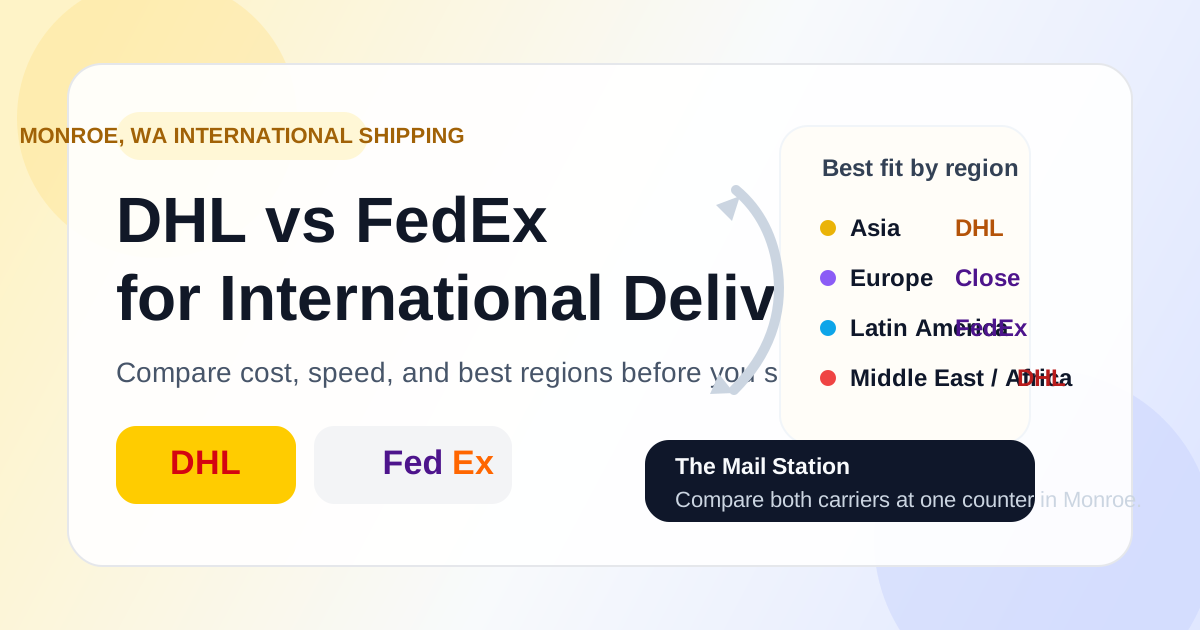
How to Ship to China: Rates, Customs & What's Banned
Real 2026 rates for FedEx, DHL, and USPS to China, customs rules that actually get enforced, and the items China won't let in.