
Blog Topics:
Mexico RFC CURP Shipping Customs Clearance: Why Is My Package Held?
Mexico RFC CURP Shipping Customs Clearance: Why Is My Package Held?
Tracking freezes in Mexico. The carrier asks for a tax ID you have never typed on a domestic label. This is usually paperwork literacy — not a vanished box.
Mexico RFC CURP shipping customs clearance often stalls when the consignee’s Mexican tax ID (RFC) or population ID (CURP) is missing, mistyped, or does not match the name and address on the waybill. DHL’s public Mexico regulatory guidance says express low-value informal/simplified entries need the importer/consignee’s name, address, and Tax ID, and that if the Tax ID is not provided the shipment may face clearance delays, extra processing/storage fees, or return to origin (DHL Mexico regulatory 2024). FedEx Mexico’s simplified-shipment guidance similarly treats RFC or CURP (when the consignee has no RFC), plus full name, address, and phone, as mandatory for many simplified clearances — with foreign tourists steered to SSN, home-country Tax ID, or passport number instead (FedEx Mexico simplified shipment form). None of that is a duty calculator, and none of it means a Monroe counter can guarantee clearance. It does mean the fields you put on the commercial invoice and air waybill before the box leaves Old Owen Road matter more than most people expect.
This page is RFC/CURP consignee-tax-ID literacy for clearance holds — invoice and waybill fields, calm counter help, and what we will not invent. It is not a full “how to ship anything to Mexico” guide. For carrier options that usually arrive, start with how to ship to Mexico from Monroe. For Canada vs Mexico stall patterns, see shipping to Canada vs Mexico. For general customs-form anatomy, use the international shipping customs forms guide. For “held at customs” after the fact, see package held at customs — what to do.
The US-2 counter moment (why this page exists)
A Monroe shipper walks in with a sealed carton for family in Guadalajara — or a stack of immigration paperwork headed to Mexico City — and a screenshot that says something like “importer registration” or “tax ID required.” They already chose a carrier in their head. What they actually need next is quieter: the consignee’s correct ID string, spelled the same way on every form, before DHL or FedEx can finish release on the Mexico side.
That is the profitable, calm lane we see locally: urgent personal and legal documents, gifts, and personal effects where a hold is expensive in time, not just money. Our job at the counter is invoice literacy and carrier choice, not customs brokerage. Soft-landing international shipping and DHL shipping here means we help you fill fields and pick a service that fits documents vs merchandise — not that we clear the package with SAT or ANAM.
RFC and CURP in plain English (for US shippers)
You do not need a Mexican tax degree to ship. You need the right string from the person receiving the package.
RFC — Registro Federal de Contribuyentes. This is Mexico’s federal taxpayer ID, administered by SAT (Servicio de Administración Tributaria). Businesses and individuals who are registered taxpayers use an RFC on tax and many customs-facing documents. In shipping language: the consignee’s Mexican tax ID, when they have one.
CURP — Clave Única de Registro de Población. This is Mexico’s unique population-registry key (identity/population ID), not the same thing as an RFC. Carriers and simplified-entry rules often allow CURP in lieu of RFC when the consignee does not have an RFC — FedEx Mexico’s simplified form language says exactly that: RFC, or CURP when there is no RFC (FedEx Mexico simplified shipment form). DHL’s Mexico regulatory page groups the ask as Tax ID (RFC) / Personal ID (CURP) for importers/consignees in Mexico (DHL Mexico regulatory 2024).
What to ask your recipient before you tape the box:
- “What is your RFC as it appears on your tax paperwork?”
- If they say they have no RFC: “What is your CURP, exactly as issued?”
- If they are a foreign tourist / non-resident without Mexican IDs: ask what the carrier portal is requesting (passport number, home-country tax ID, or SSN are the FedEx examples for foreign tourists — always confirm in the live shipping flow, not from a blog memory).
Copy-paste from a photo of their ID card beats typing from memory. A single wrong character is enough to look like a “mismatch” on the Mexico side.
Why carriers suddenly care (2024–2025 Mexico express rules)
Mexico tightened data requirements for many low-value informal/simplified express (courier) entries — often discussed under Pedimento Clave T1 / General Foreign Trade Rules changes. DHL’s customer explainer for the October 2024 SAT/customs changes is blunt: for informal/simplified express entries below US$2,500, DHL must provide importer/consignee name, address, and Tax ID, on top of AWB number, detailed goods description, and total value. If the consignee has no Tax ID, a Personal ID — or for foreigners a foreign Tax ID or Personal ID — must be provided. Missing Tax ID can mean delays, processing/storage fees, or return to origin (DHL Mexico regulatory 2024).
FedEx Mexico’s simplified-shipment page describes related regulatory modifications for e-commerce / express simplified clearance, with mandatory complete names, full delivery address, RFC or CURP, and phone — and notes that failure to comply can mean return to origin at the shipper’s expense or abandonment in favor of Mexico’s National Customs Agency (ANAM) (FedEx Mexico simplified shipment form).
You do not need to memorize Pedimento codes at the Monroe counter. You do need to treat consignee tax/population ID as a first-class field, the same way you already treat phone number and street address.
Invoice and waybill checklist (before the label prints)
Use this as a ship-from-Monroe preflight — not as a broker checklist and not as a promise that Mexico will release on a fixed clock.
Consignee identity block (copy exactly)
- Full legal name matching the ID the carrier will use (no nickname-only labels).
- Complete Mexican delivery address (street, number, colonia/neighborhood, city, state, postal code).
- Working phone number for the consignee in Mexico.
- Email when the carrier or e-commerce flow requires it (FedEx notes email is mandatory for some e-commerce-origin shipments).
- RFC if the consignee has one — characters exact.
- CURP if they have no RFC and the carrier accepts CURP in lieu.
- For foreign tourists / non-Mexican consignees: the ID type the carrier form asks for (passport / foreign tax ID / SSN examples appear in FedEx’s guidance — follow the live form).
Goods and value block (still required)
- Precise contents description — not “gift,” “misc,” or “documents” when the carton holds merchandise. DHL explicitly warns that generic descriptions will not be accepted by Mexico Customs (DHL Mexico regulatory 2024). FedEx’s simplified form likewise rejects vague descriptions.
- Honest declared value and currency.
- Quantity and unit where the form asks.
- Country of origin / manufacture when requested.
- Shipper contact that can answer a clearance call during Mexico business hours if needed.
Documents-only vs merchandise (say it clearly)
- If you are sending paperwork only (immigration packets, school records, contracts), describe it as documents/paper and keep the carton free of undeclared goods.
- If you are sending goods, do not hide them behind a “documents” description — that mismatch creates holds, not speed.
- For how document shipments differ from packages in general, see how to ship documents internationally — then come back here for the Mexico tax-ID fields that page does not own.
We can help you choose wording at a staffed international shipping counter and compare DHL vs FedEx for the carton in your hands. We will not invent a duty amount or swear the entry will clear tomorrow morning.
The “generic RFC XEXX010101000” trap (read carefully)
You may see XEXX010101000 online as a “generic foreigner RFC.” That string is real in SAT’s CFDI (Mexican digital tax invoice) world: Mexican tax rules use generic RFC keys when a RFC is not available, and XEXX010101000 is the generic key commonly cited for operations with residents abroad who are not registered in the RFC (alongside XAXX010101000 for certain domestic “general public” cases). SAT’s Anexo 20 filling guide and related CFDI guidance discuss the foreign generic RFC in that invoicing context (SAT Anexo 20 guía de llenado CFDI).
That is not the same as permission to stamp XEXX010101000 on every DHL or FedEx Mexico waybill “just to clear.” Express-carrier Mexico guidance we verified asks for the importer/consignee’s own Tax ID (RFC), CURP/personal ID, or — for foreigners — a foreign Tax ID / personal ID / passport / SSN as the form allows. Putting a CFDI placeholder where the carrier expects the recipient’s real registrant ID is a common way to create a mismatch hold, not a clever shortcut.
Calm rule at our counter: use the ID your consignee (or the live carrier form) actually provides. Do not invent a generic code because a forum thread said it “always works.”
What a tax-ID hold usually looks like (and what to do)
Symptoms
- Tracking stuck in Mexico clearance / customs / “importer info required.”
- Carrier email or SMS asking for RFC, CURP, tax ID, or “importer registration.”
- A request to confirm consignee name spelling against the ID.
Calm order of operations
- Open the carrier’s own tracking and message thread — not a random link from an unknown number.
- Ask the consignee for a clear photo of the RFC or CURP (or the foreign ID the form lists).
- Reply with the exact string and matching full name; do not paraphrase.
- Confirm the commercial invoice PDF / ETD matches what you just sent.
- If you booked through our counter, bring the tracking number in and we will help you read what the carrier is asking — we still cannot force ANAM or the carrier broker to release on your deadline.
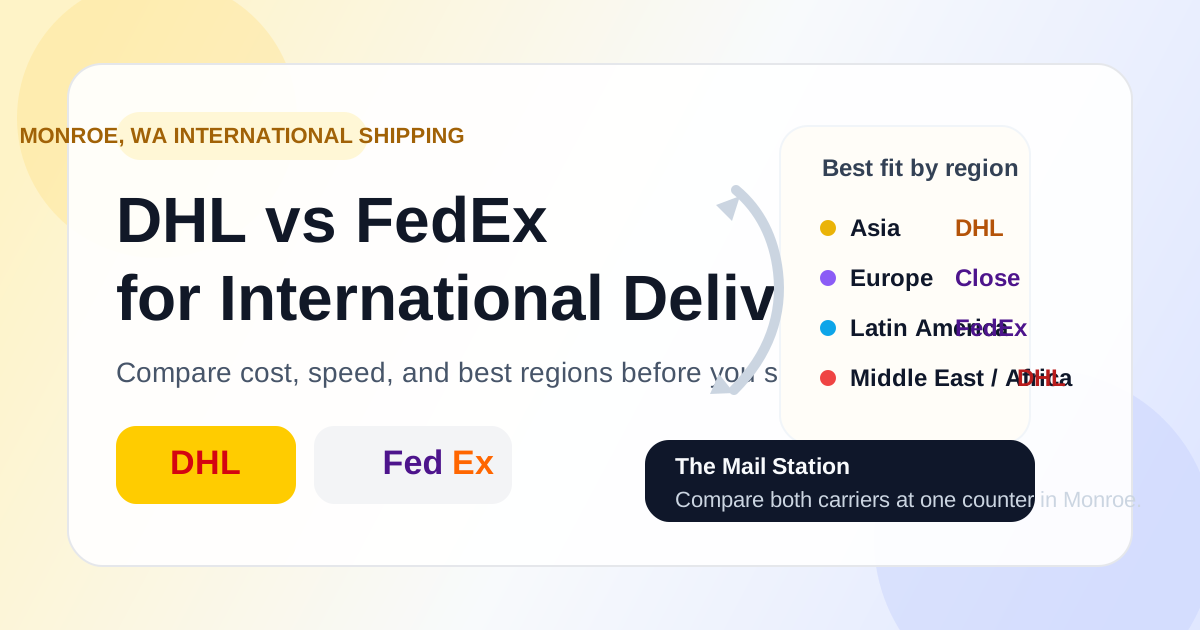
If the hold is broader than tax ID (duties, restricted goods, vague descriptions), the package held at customs guide is the companion page. Carrier comparison for international lanes lives in DHL vs FedEx international shipping.
Documents and immigration packets (soft-land, no overclaim)
Families on the US-2 corridor often need passports, apostilles, school records, or immigration support paperwork into Mexico or elsewhere in LatAm on a real calendar. That demand is why this literacy post exists.
What we can do locally:
- Help you complete customs and waybill fields so RFC/CURP (or the accepted foreign ID) is present before tender.
- Help you choose between DHL and other international options for documents vs merchandise.
- Help with custom packing when papers need a rigid mailer or carton that survives the trip.
- Walk the international shipping process at a staffed counter so you leave with a receipt and a tracking number you can share with the recipient.
What we will not claim:
- That we are a customs broker, immigration lawyer, or SAT/ANAM agent.
- That any carrier guarantees clearance on a date you need for a hearing or visa appointment.
- Invented duty percentages, approved-tax-ID lists, or “always use XEXX…” rules.
- That overseas official-docs courier shopping is finished on this page — that comparison is a separate topic in the queue; this post stays on tax-ID clearance literacy.
Soft help at The Mail Station Monroe
We are a staffed shipping counter at 19916 Old Owen Rd, Monroe, WA 98272, (360) 805-9250. Weekdays 9:00 AM–6:00 PM; Saturday 9:00 AM–2:00 PM PT — not a late afternoon Saturday window.
Bring:
- The carton or documents ready to pack.
- Consignee full name, address, phone, and RFC or CURP (or the foreign ID the carrier form will accept).
- A plain-English list of contents and values.
We will help you fill the forms, choose a sensible international service, and avoid the most common blank-field mistakes. Clearance still belongs to Mexican authorities and the carrier’s brokerage process — not to our stamp.
Short FAQ
Does every shipment to Mexico need an RFC?
Many express/simplified clearances now expect a consignee Tax ID (RFC) or an accepted substitute (CURP / foreign personal or tax ID), per carrier guidance such as DHL’s Mexico regulatory page and FedEx Mexico’s simplified form. Follow the live label flow for your shipment type; do not assume a domestic US label template is enough.
Can I use CURP instead of RFC?
Often yes when the consignee has no RFC — FedEx Mexico’s simplified form states CURP may be used in lieu of RFC in that case. Confirm on the form you are filling; do not skip the field.
Should I put XEXX010101000 on the waybill?
Not as a default “foreigner cheat code.” That generic RFC appears in SAT CFDI invoicing guidance for certain foreign-resident cases. Carrier express clearance asks for the consignee’s real Tax ID / personal ID (or foreign ID as allowed). Inventing a placeholder can create a mismatch hold.
We are not a customs broker — can you still help?
Yes, with forms literacy and carrier choice at the counter. No, with guaranteed release, duty quotes we invent, or legal immigration advice.
Documents only — do I still need the tax ID fields?
If the carrier’s Mexico clearance path still requires importer/consignee Tax ID for that entry type, yes — documents do not magically erase the data fields. Describe contents accurately as documents/paper and complete the ID block the form shows.
Bottom line: Mexico RFC CURP shipping customs clearance fails most often on missing or mismatched consignee tax/population IDs, not on mysterious bad luck. Get the RFC or CURP (or the foreign ID the carrier form accepts) from the recipient first, put the same spelling on the invoice and waybill, describe contents precisely, and use a staffed Monroe counter when you want a second set of eyes — without expecting anyone here to broker Mexican customs or guarantee the release date.
Need Professional Mail & Shipping Services?
The Mail Station has been serving Monroe, Sultan, and Gold Bar since 1982. We offer secure mailbox rentals, professional shipping services, and expert advice.
Related Articles

How to Ship to Mexico: Options That Actually Arrive
Shipping to Mexico fails more than any other route. Which carriers actually deliver, what it costs in 2026, and how to avoid customs limbo.
Why Your Package Clears Canada but Stalls in Mexico
Canada gives US shippers a CA$40 tax-free break. Mexico drops that break at just $50 and adds Spanish paperwork. Here's why the same box behaves differently.