
Blog Topics:
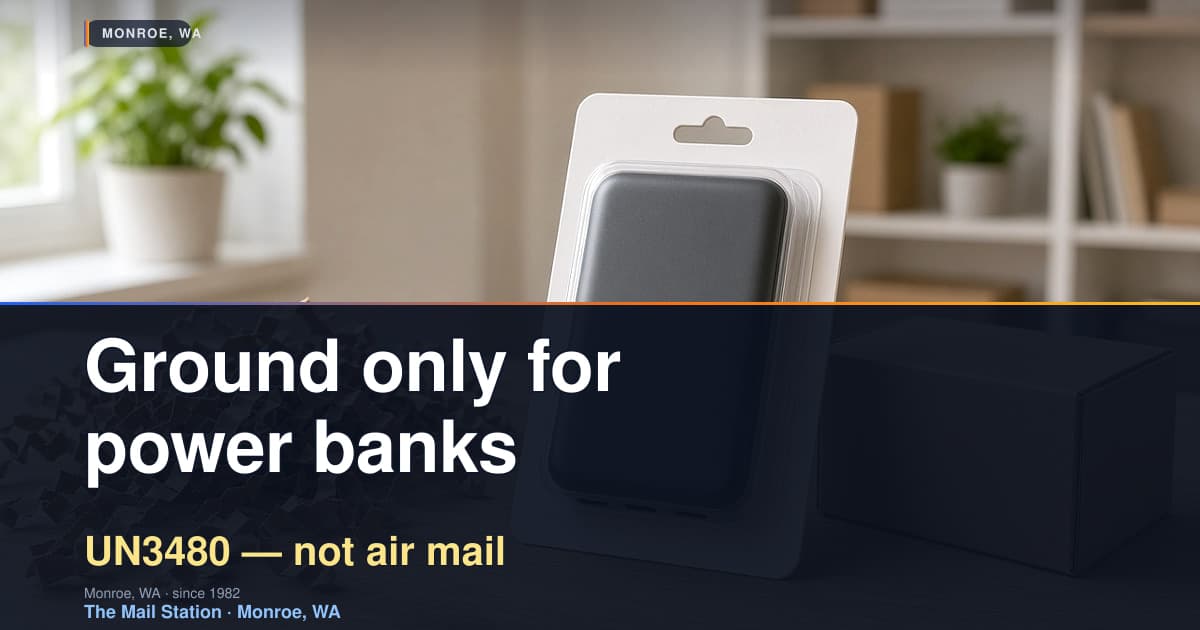
Can You Ship a Power Bank? What USPS, FedEx & UPS Allow
Can You Ship a Power Bank? What USPS, FedEx & UPS Allow
Yes — but only on the ground, only in the original packaging, and never on a passenger plane. Here's what the label actually has to say.
Yes, you can ship a standalone power bank. USPS, FedEx, and UPS all classify it as a UN3480 lithium-ion battery, not as ordinary electronics — which means ground/surface transportation only, a watt-hour cap of 100 Wh per battery, and a package limit of 5 pounds for USPS mail (USPS Packaging Instruction 9D). Air transport is prohibited for a loose power bank no matter which carrier you use, and the box has to carry a lithium-battery mark that says so. Skip the marking or try to send it Priority Mail Express, and it gets pulled at the counter or bounced at the sort facility.
A customer came in a few weeks back holding two brand-new portable chargers, still in the blister packaging, trying to send them to a kid who'd just started college. Simple gift, they figured — same as mailing a phone charger cable. We had to stop and explain that a phone charger and a phone charger battery are not the same conversation with the carrier. One's just wire and plastic. The other is regulated cargo the second it leaves the box it came in.
Why a Power Bank Isn't the Same as the Battery in Your Phone
We wrote about shipping a used phone with the battery still installed a few weeks ago, and the question we hear most often after that post is some version of "so a power bank is the same rule, right?" It isn't, and the difference matters.
A battery sitting inside a phone, laptop, or tablet is UN3481 — "contained in equipment." The device itself acts as part of the packaging, and carriers give contained-in-equipment batteries more room: air transport is usually fine, and the quantity limits are looser.
A power bank has no equipment around it. It is the battery. That makes it UN3480 — standalone lithium-ion — and standalone batteries get the strictest treatment on every carrier's chart. Same chemistry, same size battery even, completely different mailing rules, because the risk carriers care about is a cell shorting out with nothing but a cardboard box between it and the rest of the cargo hold.
USPS: Ground Only, Sealed Packaging, and a Real Weight Cap
USPS Publication 52, Packaging Instruction 9D, spells out the rule for "individual batteries mailed without equipment" in plain terms: lithium-ion batteries without equipment are mailable domestically via surface transportation only, provided the battery is in its originally sealed packaging and marked correctly (pe.usps.com).
The specifics that actually change what you can send:
- Watt-hour limit: each cell capped at 20 Wh, each battery capped at 100 Wh. Most phone-charger-sized power banks (10,000–20,000 mAh) land around 37–74 Wh, so they clear this easily. Big "solar generator" style power stations often don't.
- Weight limit: the mailpiece can't exceed 5 pounds total.
- Packaging: USPS wants the battery in its original sealed retail packaging — the blister pack or box it shipped in, not a random envelope with a loose battery rattling around.
- Marking: the box needs a DOT-approved lithium-battery mark showing "UN3480" and the text "Surface Mail Only, Secondary Lithium Batteries — Forbidden for Transportation Aboard Passenger Aircraft" (or the lithium-ion equivalent wording) on the address side.
There's one narrow exception worth knowing about, mostly as trivia: USPS allows very small lithium-ion batteries (2.7 Wh or less — think coin cells, not power banks) onto air transport in limited quantities, and a separate Alaska-specific air allowance exists for lithium-ion batteries under 349.24. Neither one covers a normal phone or laptop power bank, which sits well above 2.7 Wh. Don't count on either exception at the counter.
FedEx and UPS: More Flexibility, More Paperwork
FedEx and UPS both classify a standalone power bank the same way — UN3480 — and both prohibit it on passenger aircraft regardless of the watt-hour rating (FedEx battery shipping guide). Where they differ from USPS is in what ground shipping requires.
Under the IATA Section II exception that FedEx and UPS both build their small-package rules around, a lithium-ion battery under 100 Wh per battery and 20 Wh per cell can usually ship without a formal Shipper's Declaration for Dangerous Goods, as long as it's packaged and marked correctly — inner packaging that prevents short circuits, a Class 9 lithium-battery mark with the UN3480 number, and quantity limits per package. Go over those limits, or the state of charge exceeds 30% for an air-eligible shipment under Section IA/IB, and you're into full dangerous-goods paperwork territory, which most retail counters aren't set up to process for a one-off personal shipment.
Two practical points that catch people off guard:
- Not every counter takes it. FedEx Office and standard drop boxes don't accept full dangerous-goods shipments — only battery shipments that qualify for the lighter Section II exception. A FedEx-authorized ship center that handles regulated shipments is a different conversation than a drop box in a convenience store.
- UPS runs a parallel version of the same rule. Same UN3480 classification, same ground-only reality for standalone batteries, same packaging and marking requirements — worth checking UPS's own battery page before assuming your local drop-off point can process it.
Power Bank Shipping at a Glance
| USPS | FedEx | UPS | |
|---|---|---|---|
| Classification | UN3480 lithium-ion | UN3480 lithium-ion | UN3480 lithium-ion |
| Air transport | Prohibited | Prohibited on passenger aircraft | Prohibited on passenger aircraft |
| Ground/surface | Allowed, sealed retail packaging required | Allowed, with proper packaging + marking | Allowed, with proper packaging + marking |
| Watt-hour cap (no formal DG paperwork) | 100 Wh/battery, 20 Wh/cell | 100 Wh/battery, 20 Wh/cell (Section II) | 100 Wh/battery, 20 Wh/cell (Section II) |
| Package weight limit | 5 lbs | Varies by service | Varies by service |
| Marking required | DOT lithium-battery mark + UN3480 + "Surface Mail Only" text | Class 9 lithium-battery label + UN3480 mark | Class 9 lithium-battery label + UN3480 mark |
| Damaged/swollen/recalled battery | Prohibited | Prohibited | Prohibited |
What "Originally Sealed Packaging" Actually Means
This is the part that trips up sellers the most. USPS's rule doesn't just want the battery boxed up carefully — it wants the battery in the manufacturer's original sealed retail packaging, the blister pack or box it was sold in. A brand-new power bank still in its shrink wrap clears this without a second thought.
A used one — pulled out of a junk drawer, sold secondhand on Facebook Marketplace, no box in sight — is a harder conversation. The honest answer is that a loose used battery with no original packaging doesn't cleanly meet the retail-packaging condition, and the safer move is a compliant hard-sided battery bag or case that isolates the terminals and prevents short-circuiting, with the same UN3480 marking applied. If you're not sure your packaging actually isolates the terminals the way the rule intends, that's exactly the kind of judgment call a counter that handles lithium shipments regularly is used to making.
When We Have to Say No at the Counter
A power bank that's swollen, cracked, been dropped hard enough to dent the casing, or is under a manufacturer recall doesn't get a workaround — every carrier prohibits shipping a damaged, defective, or recalled battery, full stop, "unless approved by the director, Product Classification" on the USPS side. If it's puffed up even slightly, that's not cosmetic. That's the battery telling you it's already failing.
The other no we give more often than people expect: big power stations. The camping and RV crowd along the US-2 corridor has made these popular — the 500 Wh-plus "solar generator" units that can run a mini-fridge or charge a laptop a dozen times. Those blow past the 100 Wh mailable threshold and move into freight-class handling with its own contract requirements, not a retail parcel counter. If you're shipping one of those, that's a call to the carrier before you pack anything, not a box you drop off and hope for the best.
How to Mail a Power Bank the Legal Way
- Check the watt-hour rating. It's printed on the power bank itself, usually near the barcode. Under 100 Wh, you're in normal shipping territory. Over 100 Wh, you're looking at freight.
- Keep it in original retail packaging whenever possible, or use a compliant battery-safe case if it's used.
- Inspect for damage. No swelling, cracks, or heat damage. If it feels warm sitting in a drawer, don't ship it — get it recycled instead.
- Choose ground/surface service. Don't select Priority Mail Express, Next Day Air, or any air-based service — it will be rejected or delayed at sorting.
- Mark the box correctly. UN3480, the lithium-battery mark, and the "Surface Mail Only / Forbidden for Transportation Aboard Passenger Aircraft" language on the address side.
- Ask before you assume a drop box works. Convenience-store drop boxes and unstaffed kiosks aren't the place for a labeled hazmat shipment — a staffed counter that handles battery shipments regularly is.
Frequently Asked Questions
Can you ship a power bank in the mail? Yes. USPS allows a standalone lithium-ion power bank via surface (ground) mail only, in original sealed packaging, under 100 Wh per battery and 5 pounds per package, with the correct UN3480 marking (USPS Packaging Instruction 9D).
Can I ship a power bank with FedEx or UPS air service? No. All three carriers prohibit a standalone lithium-ion battery — UN3480 — on passenger aircraft regardless of watt-hour rating. Ground/surface service is the legal path for a power bank shipped alone.
Do I need a special label to ship a power bank? Yes. The package needs a DOT-approved lithium-battery mark showing the UN3480 number and text noting it's forbidden from passenger aircraft. A plain shipping label with no hazard marking isn't correct for a standalone battery, even if the carrier's system lets you print one.
What if my power bank doesn't have its original box anymore? USPS's rule is written around the battery being in its originally sealed retail packaging. Without that, the safer route is a purpose-made battery-safe case or bag that isolates the terminals, still marked UN3480. If you're unsure, a counter that regularly handles lithium shipments can tell you whether your packaging actually qualifies.
Can I ship a large power station or solar generator battery? Usually not through a standard parcel counter. Units over 100 Wh — many of the popular camping "solar generator" power stations — exceed the mailable and Section II exception limits and typically require freight-class shipping with its own contract, not a retail drop-off.
What We'll Help With at the Counter
If you're not sure whether your power bank clears the watt-hour cap, needs a compliant case instead of loose packaging, or qualifies for ground shipping at all, bring it in. We check the rating, confirm the packaging, and mark the box correctly before it leaves — the same way we do for fragile and awkward items every week. What we won't do is ship a swollen or recalled battery, or pretend a 500 Wh power station is a normal parcel.
The Mail Station 19916 Old Owen Road, Monroe, WA 98272 (360) 805-9250 Mon-Fri 9 AM-6 PM · Sat 9 AM-4 PM · 24/7 mailbox access First month free for new customers Contact us
Related Reading
Can You Ship a Used Phone With the Battery Still In It? — the installed-battery (UN3481) version of this same question, with different rules.
What Can't You Ship via USPS, FedEx & UPS? (2026 Guide) — the full restricted-items list power banks sit inside.
Can You Ship Ammunition? What USPS, FedEx & UPS Allow — another item where the honest answer is "with real restrictions, not a workaround."
Can You Ship Perfume? The $50 Mistake to Avoid — a different hazmat classification with its own expensive mistake to avoid.
How to Ship Fragile, Valuable, and Awkward Items Without Losing Sleep — the packing help that pairs with a compliant battery shipment.
Shipping Heavy or Oversized Items: Limits, Fees & Hacks — where the big solar-generator-style power stations actually belong.
Why Shipping Insurance Claims Get Denied (2026) — misdeclared or improperly labeled hazmat is one of the fastest ways a claim gets denied.
Selling on Etsy, eBay or Amazon? Keep Your Home Address Off the Internet — for the sellers who ship the most power banks and chargers.
Explore Services
Written by the team at The Mail Station Monroe — helping Monroe, Sultan, Gold Bar, Snohomish, Duvall, and Granite Falls residents ship the hard-to-classify stuff correctly since 1982. Educational only, not a substitute for the current carrier rulebook — confirm your specific battery's watt-hour rating and packaging with USPS Publication 52 or your carrier before shipping.
Need Professional Mail & Shipping Services?
The Mail Station has been serving Monroe, Sultan, and Gold Bar since 1982. We offer secure mailbox rentals, professional shipping services, and expert advice.
Related Articles

Can You Ship Ammunition? What USPS, FedEx & UPS Allow
No — USPS bans it outright. FedEx and UPS allow ammo only via a hazmat business account, ground-only, picked up at their own counters, never yours.
Can You Ship a Used Phone With the Battery Still In It?
Yes — but USPS bans air transport for used, damaged, or defective battery devices. Ground only, labeled right, or you risk a new $50 USPS fee.