
Blog Topics:
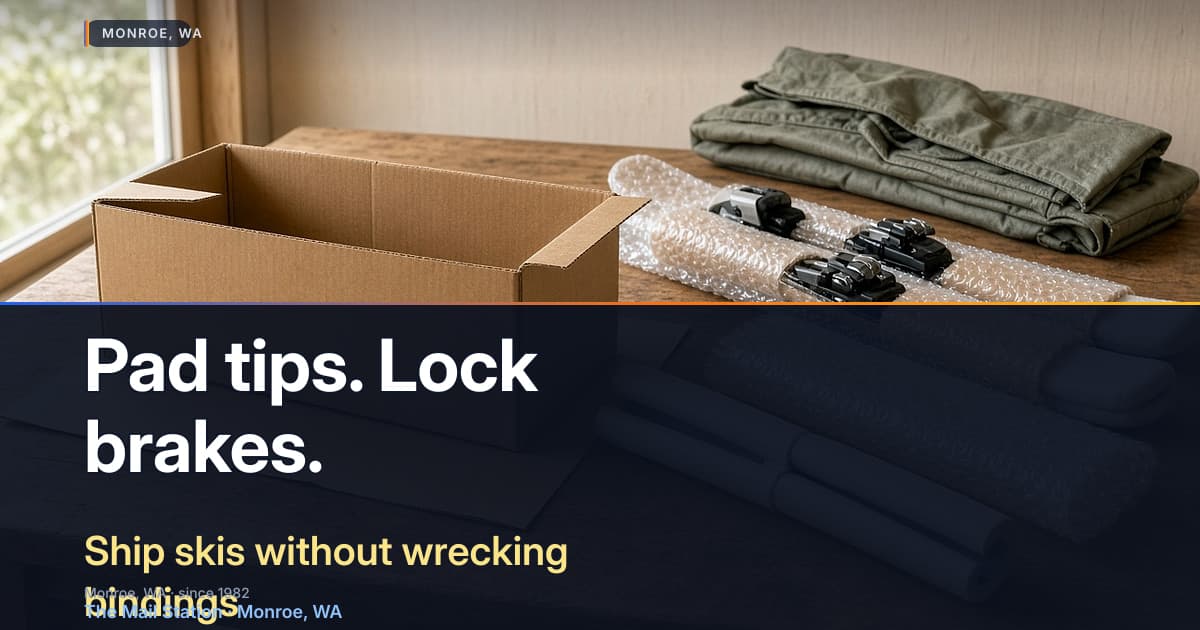
How to Ship Skis Without Damaging Bindings — Box vs Soft Bag
How to Ship Skis Without Damaging Bindings — Box vs Soft Bag
A soft ski bag looks ready for the truck until a brake lever catches a zipper — or an empty long box turns tip-to-tail travel into tip-through-cardboard.
How to ship skis without damaging bindings starts with three boring steps that save most claims: dry the gear, lock or retain the brakes, and pad tips, tails, and binding hardware so nothing can punch the carton or snag the bag. Carriers will take a long carton when it fits their size and weight rules — FedEx's own packing guide calls out skis as an item that often needs a tie-on tag for the label when you ship in a bag or irregular outer (FedEx How to Pack); UPS expects a rigid corrugated outer with enough cushioning that contents do not shift (UPS packaging guidelines); USPS caps most parcels at 70 lb and 130 inches length plus girth, with an oversized price band when length plus girth runs past 108 inches (USPS parcel size standards). None of that is a packing mystery — it's measuring before you tape.
We see this every fall along the US-2 corridor: someone from Monroe, Sultan, Gold Bar, or Snohomish sells a pair online after a Stevens Pass season, or mails a board to a kid at school, and the first draft of the package is a soft travel bag with the bindings still "live." It works for a car roof rack. It is a different animal on a conveyor.
What Actually Breaks (It Usually Isn't the Sidewall)
Ski and snowboard damage in transit almost never starts with a mysterious crush in the middle of the deck. It starts at the parts that stick out:
- Brake levers and heel pieces that catch bag fabric, strapping, or another pair in the same carton
- Sharp steel edges that slice foam, then cardboard, then the next package in the sort
- Tips and tails that act like spears when the carton has empty air at either end
- Bindings that were never dried, so moisture sits against metal and base material for days in a sealed box
If you only wrap the middle of the ski and hope for the best, you've protected the part that was already the least exposed.
Soft Bag vs Box (Pick for the Trip You Actually Have)
Soft ski/snowboard bags are fine when the bag is padded, fully zipped, compressed so nothing rattles, and labeled so the barcode stays readable. FedEx specifically lists skis with golf bags and luggage as items where a tie-on tag is the right way to attach the shipping label — do not wrap a paper label around a curved, soft surface and hope the scanner finds it (FedEx How to Pack). Soft outers also tend to trigger extra handling on some UPS lanes when the package is not fully encased in corrugated cardboard — that's a billing/handling reality, not a moral judgment on your bag (UPS additional charges overview).
A rigid corrugated box (double-wall when the pair is heavy or you're stacking boots and poles in the same shipment) is usually the calmer choice for a sold pair, a one-way move, or anything you will not see again until it lands. UPS's basic method is still the right mental model: choose a sound box, fill voids so nothing moves, tape the seams (UPS packaging guidelines). FedEx says the same in plainer language: sturdy box, cushioning around the item, H-tape the seams, put a duplicate address inside (FedEx How to Pack).
You do not need a branded "ski shipper" carton to do this well. You need a box long enough for tip-to-tail packing without bending the skis, with room for padding — not a moving-box cathedral that bills like a small kayak.
Packing Sequence That Protects Bindings
Work in this order. Skipping ahead is how brakes find zippers.
- Dry everything. Wipe bases, edges, and bindings. Overnight garage damp is enough to fog a week in a sealed carton.
- Secure the brakes. Use the brake retainer that came with the binding, a dedicated retainer clip, or a clean strap/zip-tie method that holds the brake up so it cannot snag. Do not force plastic into a position that stresses the binding.
- Pad the hardware. Bubble wrap or foam around binding toes/heels and any sharp hardware. Soft clothing helps as void fill after the hard edges are covered — clothing alone is not edge protection.
- Protect tips, tails, and steel edges. Foam pipe insulation, edge guards, or several layers of bubble wrap along the metal. Tips and tails get extra attention; they are the first thing to punch cardboard when the carton shifts.
- Orient tip-to-tail in the box when you are shipping a pair. Nest them so bindings are staggered, not stacked binding-on-binding. A snowboard gets full-perimeter edge wrap plus nose/tail reinforcement.
- Fill every void. Shake test: if you can hear a clack, add fill. Loose peanuts that migrate to one end are worse than denser fill that stays put.
- Seal and label. H-tape the carton seams. Put the label on the largest flat face, not over a seam. For a soft bag, use a tie-on tag. Slip a paper copy of the address inside before you close it.
That sequence is how to ship skis without damaging bindings in practice — not a product pitch, just the order that matches how hubs actually handle long cartons.
Carrier Reality for Long Winter Gear (No Guessing the Invoice)
Long winter gear sits in the awkward middle: usually still a parcel, not freight, but long enough to brush size and handling rules.
USPS. Domestic parcels generally top out at 70 pounds and 130 inches length plus girth. Parcels greater than 108 inches (but not more than 130) in length plus girth can take the oversized price; separate nonstandard length and cubic fees can also apply when a parcel is long or bulky (USPS parcel size standards). Measure the finished carton — not the ski length alone.
UPS. Small-package service has hard limits around 150 lb, 108 inches in length, and 165 inches length plus girth; packages with a long side over 48 inches (or a second side over 30 inches) can draw Additional Handling, and large-package rules kick in at higher length-plus-girth thresholds (UPS additional charges overview). A soft bag that is not fully encased in corrugated is another Additional Handling trigger on that same sheet.
FedEx. Ground parcel service uses the same neighborhood of hard ceilings many shippers already know from oversized freight triage — and FedEx's packing guide still wants irregular soft outers labeled with a tie-on tag, not a wrinkled label on fabric (FedEx How to Pack). For the surcharge ladder that sits under those hard ceilings (Additional Handling / Oversize style triggers), use a live quote on the packed carton; we already walked the peak-season size-fee calendar in our peak surcharge guide and the avoid peak oversized / additional handling post.
We will not invent a dollar figure for your pair. Length, girth, weight, service, and zone decide that at the counter — which is why measuring the finished package matters more than measuring the ski on the carpet.
If the tape measure is already past parcel limits, stop packing and read too big for FedEx/UPS parcel vs freight before you buy a longer box.
Boots, Poles, Bindings-Only Boxes
- Boots: Ship separately when you can. A boot box inside the ski carton becomes a battering ram against bindings.
- Poles: Tip covers on, shafts padded, laid parallel — not diagonal spears.
- Bindings alone (spares or a mail-in mount): treat them like dense hardware. Immobilize brakes/levers, pad every knuckle of metal, and use a snug carton so a single binding cannot migrate into a corner impact.
US-2 Corridor Notes (Monroe → Sultan → Gold Bar → Snohomish)
Cascade season means more one-way gear shipments from garages between Monroe and the pass towns — sold quivers, college send-offs, "we'll meet you at the condo" boxes. A few local practicalities:
- Measure here, not in the driveway guess. Long cartons look shorter in a hallway.
- Same-day hopes need real clock time. If you need a carton built or a multi-carrier quote, weekday daytime is calmer; Saturday we are open 9 AM–2 PM (never plan on a late Saturday window).
- Corridor drop-in is normal. Sultan, Gold Bar, and Snohomish folks use the Monroe counter for the same reason: one place to compare carriers on a long box without driving to three storefronts.
Bring the skis or board unsealed if you want a second set of eyes on brake retention and tip padding. That is ordinary custom packing help — materials and counter time, quoted before tape — not a promise that any carrier is cheaper than doing it yourself at home.
DIY Checklist (Print or Screenshot)
- Gear is dry
- Brakes retained / levers immobilized
- Tips, tails, and edges padded
- Bindings wrapped (not just the deck)
- Tip-to-tail orientation; no binding-on-binding stack
- Voids filled (shake test passes)
- Corrugated outer or soft bag with tie-on tag
- H-taped seams; label on largest flat face
- Duplicate address inside
- Finished length, girth, and weight written down before you buy a label
- Quote compared across carriers on those finished numbers
When to Ask the Counter for Help
Walk up if any of these are true:
- You only have a soft bag and the pair is sold (no do-over if a brake tears the shell)
- The carton you found is either crushing the tips or swimming in empty space
- You are close to a length or length-plus-girth line and want the carton measured the way billing systems measure
- Boots, poles, and skis are trying to share one box and something already rattles
At The Mail Station Monroe — 19916 Old Owen Rd, Monroe, WA 98272, (360) 805-9250 — we can help with custom packing for long winter gear and run a live multi-carrier quote once the carton is real. For straight shipping after it is packed, see FedEx shipping, USPS shipping, and package drop-off. Hours if you are planning a Saturday run: 9 AM–2 PM.
Related Reading
- Avoid Peak Oversized & Additional Handling Fees (2026)
- Peak Season Surcharges 2026 Calendar
- Too Big for FedEx/UPS? Parcel vs Freight
- Oversized & Heavy Package Shipping from Monroe
- Custom Packing for Fragile & Awkward Items
- Shipping Insurance & Carrier Liability
Explore Services
Need Professional Mail & Shipping Services?
The Mail Station has been serving Monroe, Sultan, and Gold Bar since 1982. We offer secure mailbox rentals, professional shipping services, and expert advice.
Related Articles

How to Ship Fragile, Valuable, and Awkward Items Without Losing Sleep — Monroe's Custom Packing Guide
Antiques, electronics, artwork, instruments, and family heirlooms all have one thing in common: if they ship in the wrong box with the wrong packing, they arrive broken. Monroe residents and small businesses trust The Mail Station's custom packing service to protect what matters most — from a single keepsake to a weekly shipment of e-commerce orders.
Peak Size Fees Start Sep 27 — How Do You Stay Under?
UPS and FedEx peak size/handling demand fees start late September 2026. Here's the packing checklist to stay under AHS, large-package, and oversize triggers.